The glass-and-fork symbol and the number inside the recycling triangle can look as if they answer the same question. They do not. The first indicates that an article is intended for food contact, or that its food use is obvious. The second identifies a resin family for sorting and recycling; it does not, by itself, certify food-contact suitability.
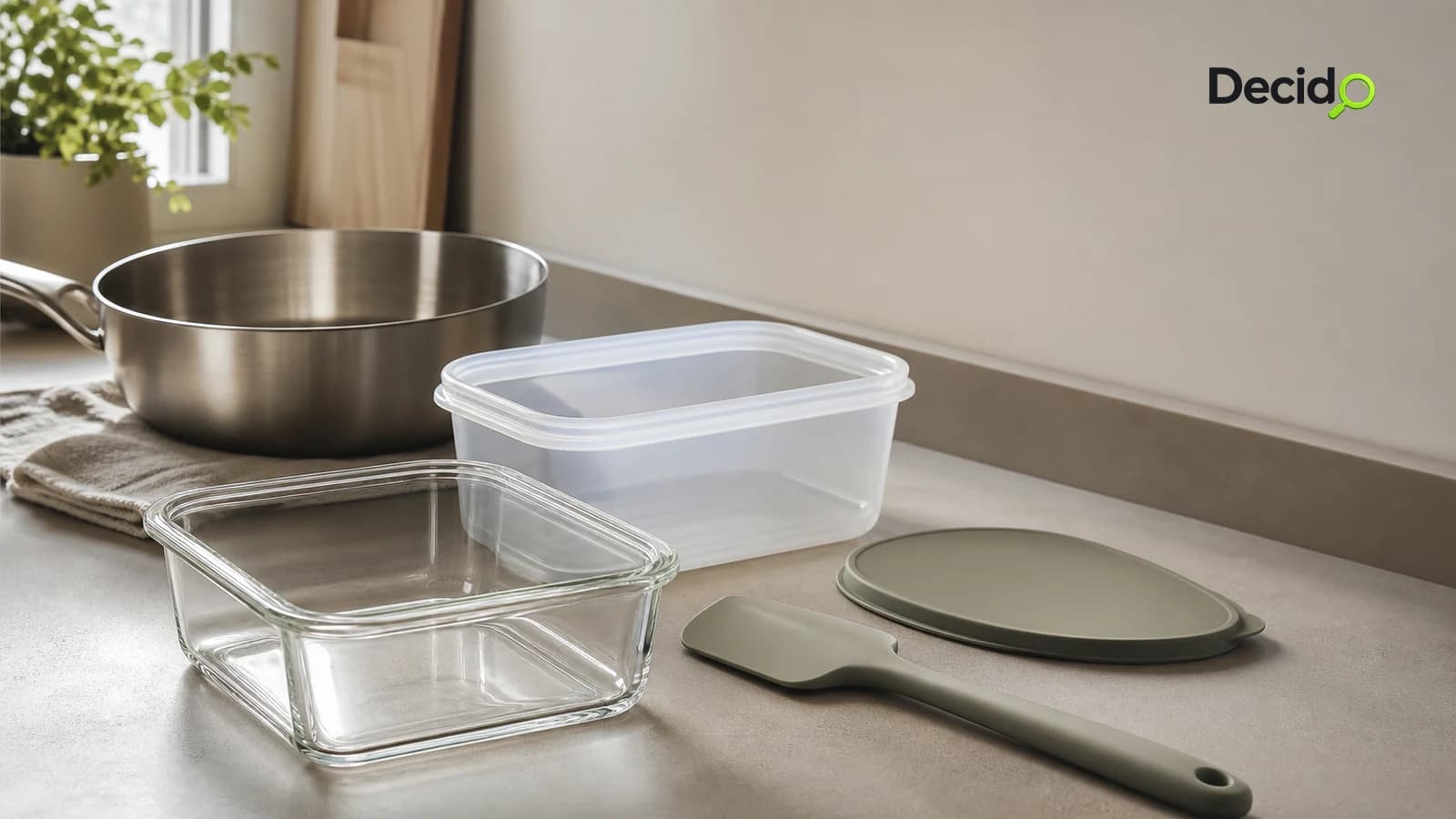
The useful question is not simply "what material is this?" It is: which material, with which food, at what temperature, for how long, and in what state of wear? A container used cold is not the same case as a tray heated in a microwave. An intact pan is not the same case as a scratched coating. This guide sets out basic criteria for reading plastic, glass, stainless steel and silicone without turning any of them into a material that is always safe or always problematic.
The starting rule: suitable does not mean unlimited
Regulation (EC) No 1935/2004 sets the general European framework for food contact materials. The principle is that materials must not transfer constituents to food in quantities that could endanger human health or unacceptably change the composition, smell or taste of the food.
That is not an absolute promise. The European Commission explains that plastics have a dedicated measure, Regulation (EU) No 10/2011, with authorised substance lists, specific migration limits and tests performed under standardised time and temperature conditions. In practice, food-contact suitability has to be read together with the intended conditions of use.
The same logic appears in the FDA's explanation in the United States: a food contact substance can be part of packaging, preparation surfaces or cookware, and the assessment considers expected migration under the intended use. The key word is "intended". An item can be suitable for storing cold food without necessarily being suitable for heating, freezing, scratching or long contact with a fatty or acidic food.
Plastic: the number on the bottom is not enough
The numbers 1-7 printed on plastic are resin identification codes. ASTM D7611 describes them as a way to identify the material and support recycling. They are not a health verdict, and they do not say whether a container is suitable for microwaving, fats, high temperatures or repeated reuse.
For plastic, at least four variables matter: polymer, additives, temperature and surface condition. Polypropylene, often marked as number 5, is used in many food containers and can be formulated for some hot-use scenarios. That does not make every number-5 container equivalent: the food-contact symbol or instructions still matter, as does whether the container is old, cloudy or scratched.
Heat is one of the most important steps. Studies on reusable containers and food pouches have measured the release of microplastics and nanoplastics in heating scenarios, especially in the microwave. This does not turn every use of plastic into a confirmed risk, but it makes the recycling number alone a weak guide. That is why the articles on heated food containers and plastic numbers should be read as specific deep dives, not as lists of good and bad materials.
Regulated substances are another part of the picture. EFSA reassessed bisphenol A, and the European Commission adopted a ban on BPA in food contact materials in 2024. This does not make all plastics the same. It shows that assessments change when new data appear, and that the chemical family, not only the generic material name, matters.
Glass and stainless steel: more stable, but still contextual
Glass is often a practical choice for storage because it is not a polymer and does not release microplastics. It is especially useful when food is hot, fatty or meant to stay in the container for a long time. Even here, the question does not end with the word glass. Lids, gaskets, inner coatings, decorations and coloured parts can be made from other materials. For microwave use, the container also needs to be declared suitable and should not have metal parts.
Stainless steel is durable, washable and suitable for many utensils and pans. The Council of Europe's technical guide on metals and alloys notes that metal ions can end up in food, which is why release limits and release testing are needed. A study in the Journal of Agricultural and Food Chemistry measured nickel and chromium release from stainless steel cookware during cooking, with more relevant effects in long acidic preparations.
This does not mean stainless steel should be avoided. It means it is not a magic material. For most household uses it is robust and predictable; for people with specific nickel sensitivity, or for very acidic and prolonged cooking, alloy composition and real use can become more important information.
Silicone: flexible does not automatically mean inert
Food-grade silicone is valued because it is flexible, performs well in the cold and can tolerate the cooking temperatures indicated by the manufacturer. It is not one single category. Formulation, curing, pigments and manufacturing quality influence the behaviour of the finished product.
Studies on silicone baking products show that siloxane migration can depend on the food and the use conditions. In one study on baking moulds, the highest migration was observed in a fatty food such as meat loaf. The practical point is not to create alarm about silicone, but to read the use information: maximum temperature, contact with fats, washing, persistent odours, changes in colour or texture, and cuts or sticky surfaces.
For spatulas, lids and moulds, silicone can be useful precisely where metal would scratch a coating. On a non-stick pan, for example, a soft utensil reduces abrasion compared with metal. But if a mould changes smell, colour or texture, wear becomes part of the assessment.
Choose by use, not by material name alone
A practical reading starts with the scenario. For cold storage of dry or low-fat foods, many food-contact containers can work. For hot, fatty or acidic foods, glass and stainless steel often become easier-to-read options because they reduce some questions about migration from polymers and additives. For microwave heating, however, an explicit suitability statement matters more than the material name alone.
- Temperature: heat accelerates many migration and degradation processes; cold, warm and boiling are not equivalent.
- Food: fats and acidity can extract different substances than water or dry foods.
- Time: a few minutes of contact are not the same as several days of storage.
- Wear: scratches, cloudiness, peeling coatings, persistent odours and sticky surfaces reduce predictability.
- Function: cutting, stirring, cooking, freezing and storing are different uses, even when the object is the same.
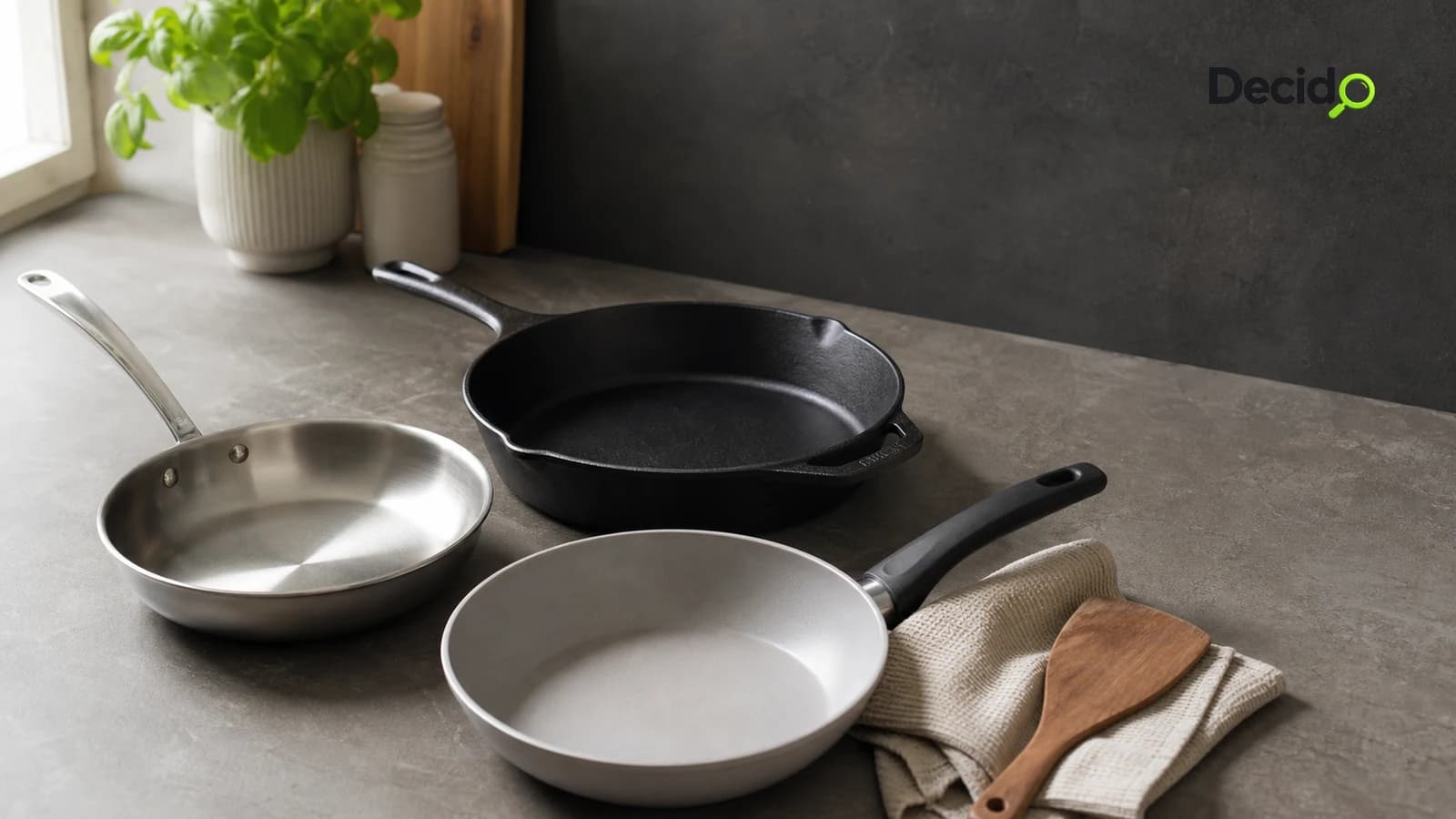
This logic connects the existing deep dives on PFAS in non-stick pans, microplastics from non-stick pans, plastic cutting boards and food containers. In every case, the key issue is never just the material name: it is the interaction between surface, food, heat and maintenance.
Conclusion
The food-contact symbol indicates an intended use. The recycling number identifies a resin. Neither one alone answers the full kitchen question. Plastic, glass, stainless steel and silicone have different profiles and different trade-offs: some are more practical cold, some are easier to interpret with heat and fats, and some help prevent scratches on delicate surfaces.
The stronger choice is not to search for a perfect material. It is to read material, use conditions, food and object condition together. When instructions are unclear, or when an item is damaged, uncertainty increases: not because the material automatically becomes dangerous, but because its behaviour becomes less predictable.
Sources cited
- European Commission, Food Contact Materials: legislation, framework for Regulation (EC) No 1935/2004 and Regulation (EU) No 10/2011.
- FDA, Food Packaging & Other Substances that Come in Contact with Food, updated 2024.
- ASTM International, D7611/D7611M Standard Practice for Coding Plastic Manufactured Articles for Resin Identification.
- EFSA, Bisphenol A and other bisphenols, topic page updated 2026.
- EDQM / Council of Europe, Metals and alloys used in food contact materials and articles, second edition.
- Kamerud K.L., Hobbie K.A., Anderson K.A., Stainless Steel Leaches Nickel and Chromium into Foods during Cooking, Journal of Agricultural and Food Chemistry, 2013, DOI: 10.1021/jf402400v.
- Hussain K.A. et al., Assessing the Release of Microplastics and Nanoplastics from Plastic Containers and Reusable Food Pouches, Environmental Science & Technology, 2023, DOI: 10.1021/acs.est.3c01942.
- Helling R. et al., Migration behaviour of silicone moulds in contact with different foodstuffs, Food Additives & Contaminants: Part A, 2010, DOI: 10.1080/19440040903341869.