In April 2024, the U.S. Environmental Protection Agency (EPA) finalised a drinking-water limit of 4 parts per trillion for PFOA and PFOS. It is one of the strictest regulatory limits on PFAS in the world. It applies to what you drink, not directly to the pan you cook in.
For non-stick pans used at 200 °C and above, the regulatory picture is less specific. This article does not claim that all pans are dangerous. It argues that peer-reviewed science has found traces, emissions and degradation in fluorinated coatings, while regulation has not yet translated those findings into a clear domestic-cookware threshold.
Why PFAS Are in Non-Stick Coatings
The most common non-stick coating on pans is PTFE, the fluorinated polymer better known as Teflon. In solid form it is chemically inert, yet it belongs to the broad PFAS chemical family.
The crucial distinction is between solid PTFE and mobile PFAS such as PFOA and PFOS. The latter were historically used as processing aids during traditional production to make the coating adhere to the underlying metal.
The review by Sajid & Ilyas, published in Environmental Science and Pollution Research International in 2017, reconstructs this process. It explains that legacy manufacturing cycles left detectable traces of PFOA and other perfluorinated compounds in finished coatings. Newer production has reduced some legacy substances, but "PFOA-free" does not answer every question about the broader PFAS family or about PTFE particle release.
What a Non-Stick Pan Releases During Cooking
Detectable PFAS in Food Migrants
The study by Toptancı et al., published in Environmental Science and Pollution Research International in 2022, analysed samples of commercial PTFE pans sold in Turkey. Researchers found detectable PFOA in part of the tested samples and showed that migration increases with temperature.
The study explicitly reports that PFCs and PAAs exhibited higher migration with increasing temperature. In practical terms, the hotter the pan gets, the more relevant migration testing becomes.
A methodological caveat is important: the samples came from the Turkish market, not from a multi-brand European screening. The data exist and are useful, but they are not exhaustive for every product on sale.
PTFE Microplastics and Nanoplastics
Another study, by Luo et al. published in Science of the Total Environment in 2022, used Raman imaging to identify and count what a non-stick pan releases during simulated cooking. The estimate runs from thousands to millions of PTFE micro- and nanoplastic particles that end up in the food simulant.
The polymer is chemically inert, but the physical presence of plastic particles in food remains a variable without a definitive long-term answer. Even when the coating is declared "PFOA-free", the PTFE structure can still release fragments visible only under a microscope.
Thermal Degradation Above 250 °C
The study by Alaboodi et al., published in Heliyon in 2024, tested PTFE coatings on aluminium alloys under rising temperatures over time. Significant structural damage appeared above 250 °C for more than 45 minutes of continuous exposure.
The study also includes a direct comparison with ceramic coatings, which showed superior mechanical stability at the same temperatures. That is a useful data point, though it does not make ceramic coatings issue-free.
A practical detail: an empty pan left on high heat can exceed 250 °C within a few minutes. Extreme conditions are not required; a short distraction can be enough to reach temperatures where coating integrity matters.
What the Law Says — and What It Does Not
The EU Has General Food-Contact Rules
In Europe, food-contact materials are governed by framework rules such as Regulation (EC) No 1935/2004 and material-specific measures such as Regulation (EU) No 10/2011 for plastics. EFSA also set, in 2020, a tolerable weekly intake of 4.4 nanograms per kilogram of body weight for the sum of four PFAS: PFOA, PFOS, PFHxS and PFNA.
That TWI is a reference for total dietary exposure across the whole diet. It is not a consumer-facing limit for the isolated contribution of one pan during one cooking session.
The U.S. Focuses on Water
The EPA, with the National Primary Drinking Water Regulation finalised in April 2024, set the Maximum Contaminant Level at 4 parts per trillion for PFOA and PFOS individually in drinking water. That is an extremely low limit, but it governs what you drink, not what you cook in.
The U.S. Food and Drug Administration regulates food-contact materials, but it has not issued a simple domestic threshold that tells consumers how much PFAS or PTFE particle release from a home non-stick pan is acceptable under ordinary cooking.
The Regulatory Gap
Neither Europe nor the United States gives consumers a clear, pan-specific number for PFAS or PTFE particle release during ordinary home cooking. General food-contact rules exist. Drinking-water rules exist. The interface between a fluorinated coating, heat, abrasion and food is less legible.
Brands often declare "PFOA-free". The problem is that PFOA is only one substance in a broader PFAS family. The claim may be true and still incomplete. It does not tell you how the coating behaves when scratched, overheated or used for years.
How to Use a Non-Stick Pan If You Already Own One
If you want to lower avoidable exposure with what you already have at home, the simplest choice is not to heat an empty pan on high. In a few minutes it can exceed 250 °C, and beyond that threshold coating degradation becomes more plausible in the literature.
Replacing the pan when the coating is scratched or peeling can help reduce particle release. Using wood or silicone utensils instead of metal ones reduces surface abrasion and the shedding of PTFE fragments.
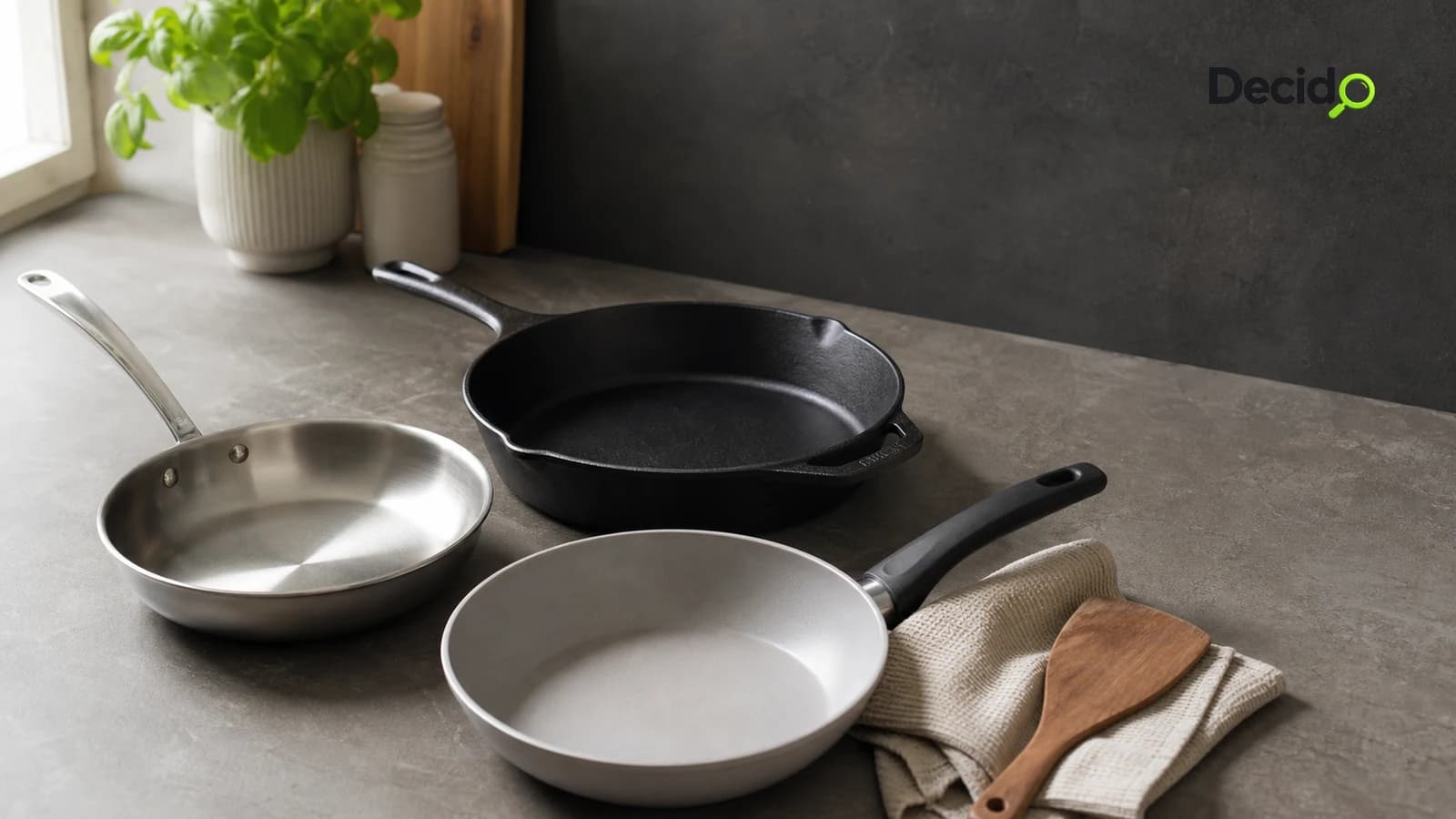
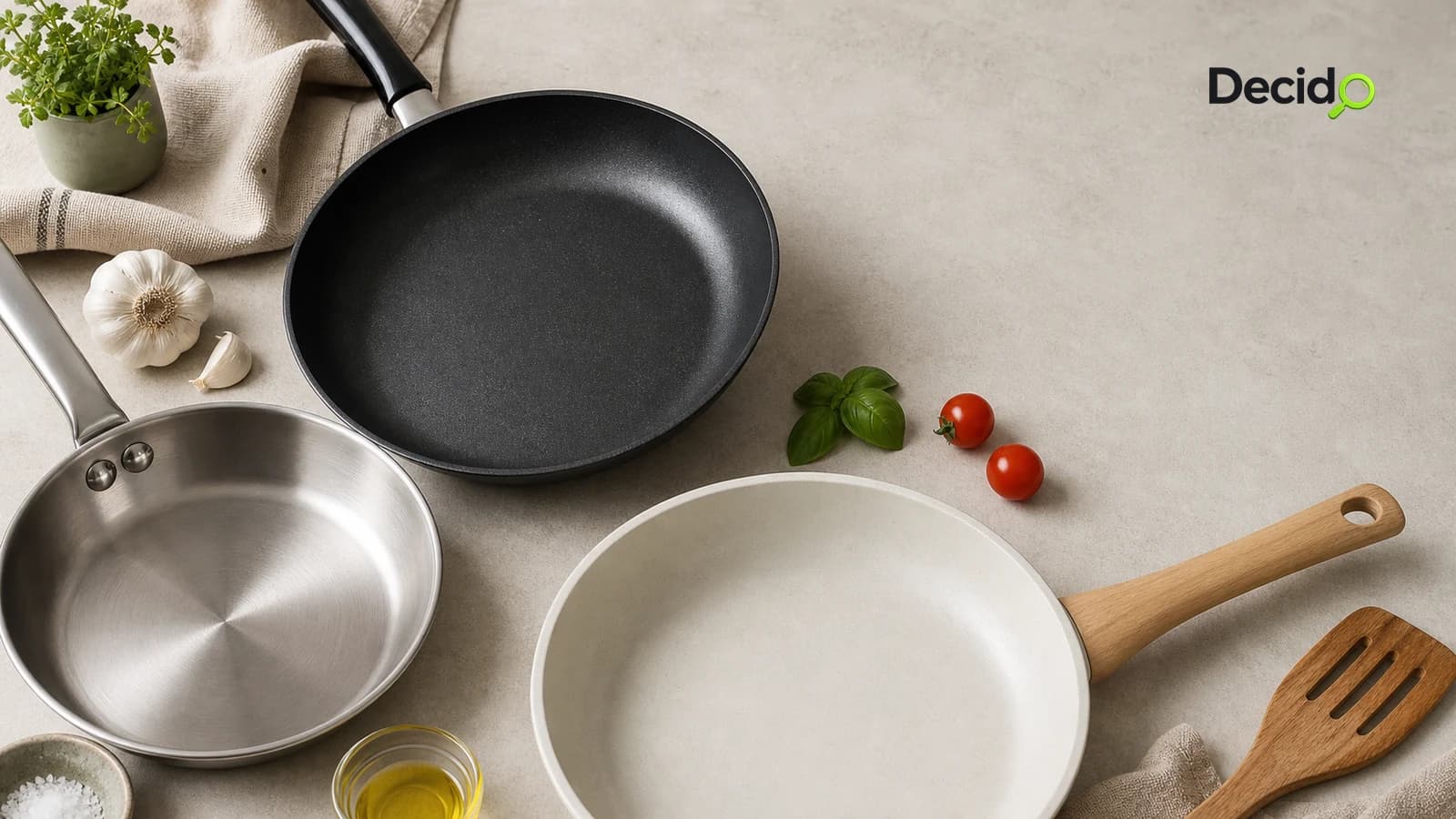
If you need to buy a new pan, options with fewer open questions at high temperatures include stainless steel, cast iron and some ceramic-coated products. They are not perfect materials and they have their own trade-offs, but the PFAS/PTFE question is different.
Conclusion
Science has documented three relevant signals: migration of some fluorinated compounds from PTFE coatings, release of micro- and nanoplastics during simulated cooking, and structural degradation above high temperature thresholds. Regulation has strict numbers for drinking water and general principles for food-contact materials, but not a simple label-level answer for the pan you use every day.
If the EPA sets 4 parts per trillion for the water you drink, what number would be reasonable for a pan used over heat? Nobody has turned that into an easy consumer threshold yet. Until they do, the practical checks remain simple: read the label, avoid overheating, and look at the state of the coating.
Cited sources
- EPA, "PFAS National Primary Drinking Water Regulation", 2024.
- EFSA CONTAM Panel, "Risk to human health related to the presence of perfluoroalkyl substances in food", EFSA Journal, 2020.
- Luo Y. et al., "Raman imaging for the identification of Teflon microplastics and nanoplastics released from non-stick cookware", Science of the Total Environment, 2022. DOI: 10.1016/j.scitotenv.2022.158293.
- Sajid M. & Ilyas M., Environmental Science and Pollution Research International, 2017.
- Toptancı I. et al., Environmental Science and Pollution Research International, 2022.
- Alaboodi A.S. et al., Heliyon, 2024.