Australian scientists Luo et al. used Raman imaging to map the particles released by non-stick pans. They published the results in Science of the Total Environment in 2022. The estimate is precise: thousands to millions of Teflon particles released during a single simulated cooking session.
The non-stick pan is sold for convenience. No one advertises it as a source of microplastics. But the scientific documents tell a different story.
The Counted Particles: Thousands to Millions per Cooking Session
The study by Luo et al. (2022) analyzed pans coated with PTFE — polytetrafluoroethylene commercially known as Teflon. They used advanced Raman imaging combined with SEM to extract the weak signal of Teflon particles.
They developed a hybrid algorithm to distinguish microplastics and nanoplastics from the background. Then they simulated a cooking process on scratched surfaces.
The final estimate: thousands to millions of Teflon particles released in a single cooking session. The particles come directly from the scratched surface of the coating. The more worn the pan, the higher the release.
The method is solid. It is one of the few studies in the world to directly quantify MP release from pans using spectroscopic techniques.
Heat and Scratches: The Two Factors That Multiply Release
A review by Alaraby et al. (2026) synthesized the evidence on PTFE, temperature, and aging. The two key factors are heat and wear. Domestic cooking temperature accelerates polymer degradation. Scratches expose underlying layers.
Brands say "PFOA-free". But PFOA is only one of thousands of PFAS. And aged coating releases PTFE and other fluorinated compounds. It is like saying a cigarette is nicotine-free but contains everything else.
A 2024 review in Heliyon (Snekkevik et al.) confirms that cooking processes influence particle release. It is not a matter of hypothesis. It is a matter of materials mechanics.
Not Just Plastic: PFAS Migration into Food
Yang et al. (2025) in Molecules analyzed the presence of PFAS in consumer products. Non-stick pans are listed as a documented source of PFAS release. Typical domestic cooking temperatures increase migration.
Ramírez Carnero et al. (2021) in Foods studied PFAS migration from food-contact materials. Non-stick coatings are among the main vehicles. PFAS migrate into food during cooking.
So the pan does not only release plastic particles. It also releases chemicals. Two distinct problems. One single tool.
If You Want to Reduce Release, the Simplest Choices Are Three
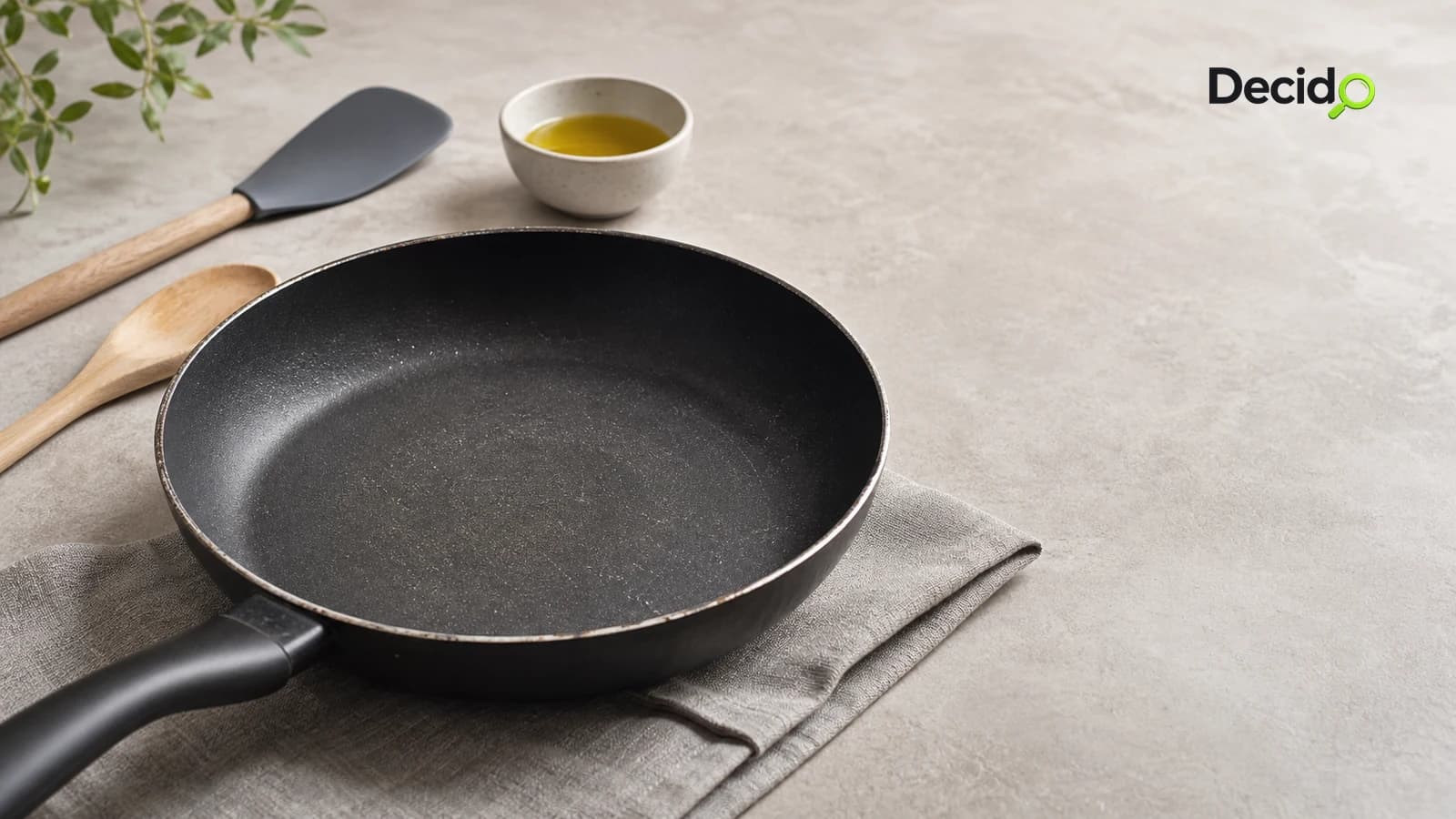
- Do not use scratched or worn non-stick pans. The study by Luo et al. (2022) shows that scratches exponentially increase PTFE release.
- Avoid very high temperatures and metal utensils that damage the coating. The review by Alaraby et al. (2026) identifies both as risk factors.
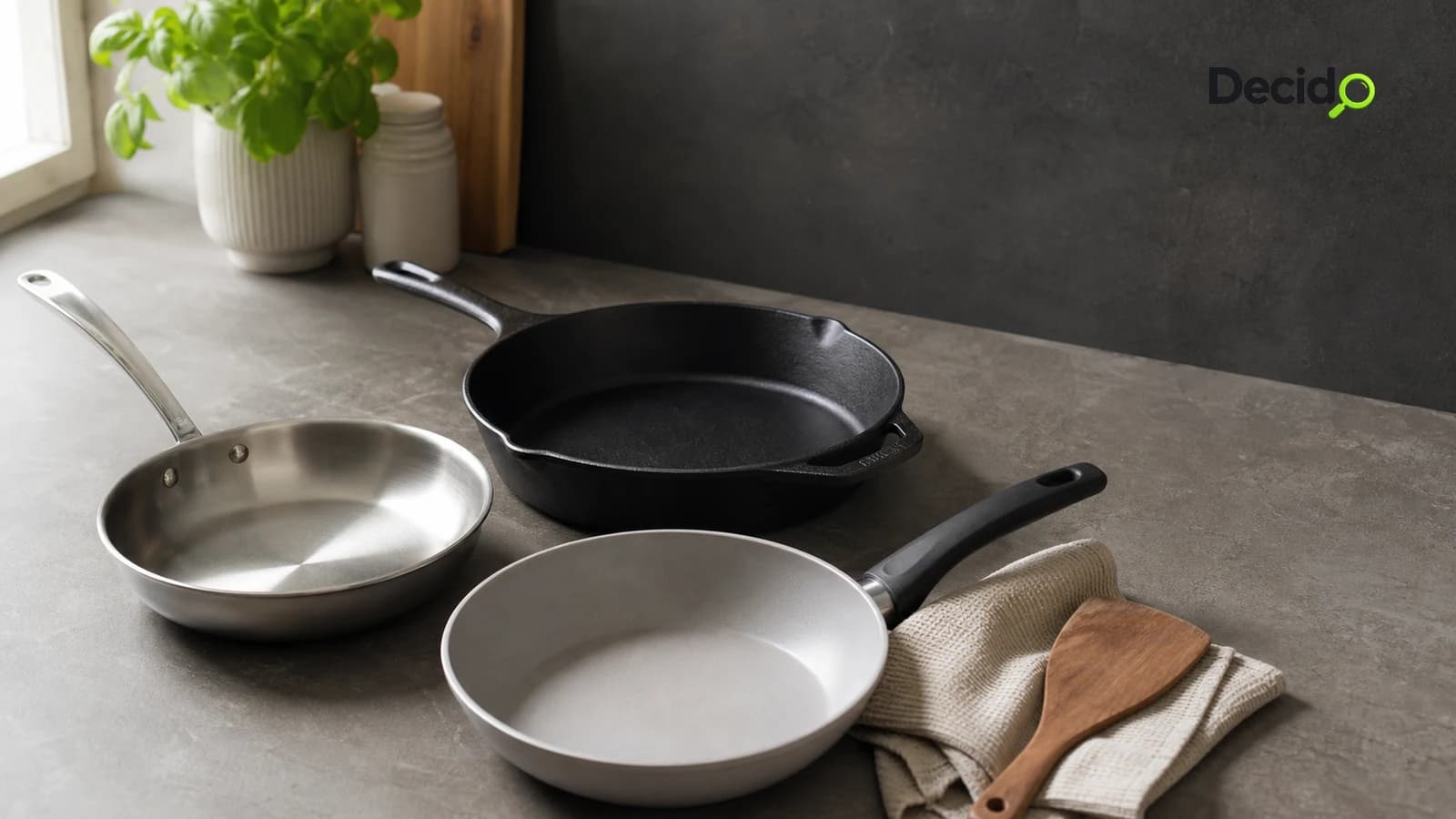
- Consider alternatives in stainless steel, cast iron, or ceramic for high-temperature cooking. These materials do not contain PTFE and do not release fluorinated compounds.
You do not have to change your whole kitchen. You just need to know that every scratch on the pan has a cost in particles.
The Question the Study Leaves Open
Non-stick pans release measurable amounts of PTFE and PFAS. Science has only just begun to count them. No specific regulation yet limits microplastic release from cookware coatings.
If a single cooking session can release millions of particles, how much do they weigh on a family's annual exposure balance if they cook every day? No one knows yet.
The only way to know is to check the condition of your pan's coating. Or have it checked by someone with no interest in hiding anything from you.
Cited sources
- Luo Y. et al., "Raman imaging for the identification of Teflon microplastics and nanoplastics released from non-stick cookware", Science of the Total Environment, 2022. DOI: 10.1016/j.scitotenv.2022.158293
- Alaraby M. et al., "Polytetrafluoroethylene microplastic properties, pollution, toxicity and analysis: a review", 2026.
- Snekkevik V.K. et al., "Beyond the food on your plate: Investigating sources of microplastic contamination in home kitchens", Heliyon, 2024.
- Yang Y. et al., "Per- and polyfluoroalkyl substances (PFAS) in consumer products: An overview of the occurrence, migration, and exposure assessment", Molecules, 2025.
- Ramírez Carnero A. et al., "Presence of perfluoroalkyl and polyfluoroalkyl substances (PFAS) in food contact materials (FCM) and its migration to food", Foods, 2021.