Liu et al. published a meta-analysis in 2025 in Journal of Hazardous Materials: Plastics that synthesizes dozens of studies on food containers. They identified one key driver: temperature-induced physical degradation. Heat does not just warm the food. It turns the container into a source of microplastics.
Containers are approved for food contact. But recent studies measure what happens when heat enters the equation. And the numbers are not reassuring.
Heat as the Driver: What the 2025 Meta-Analysis Says
Liu et al. (2025) combined a meta-analysis with a case study. They examined microplastic release data from common plastic containers.
The conclusion is clear: temperature-induced physical degradation is the main driver of release. Polymers with rougher surfaces or lower thermal stability release more particles. It is not an exotic chemical reaction. It is simple physics: heat expands and weakens the polymer matrix.
The case study quantified release under different conditions. Temperature is the factor that explains most of the variance across the different studies.
The Microwave Amplifies: Numbers from the Reusable Container Study
Hussain et al. (2023) in Environmental Science & Technology tested plastic food containers and reusable food pouches. They measured the release of microplastics and nanoplastics.
Microwave heating significantly increased release compared to room-temperature contact. The dimensional distribution of released particles was measured for different brands and polymer types.
The microwave creates rapid and uneven thermal stress. This stress accelerates surface degradation. The result is a measurable release of particles that end up in the food.
Disposable, Hot Water, and Self-Heating: Three Risk Scenarios
Liu et al. (2022) in Science of the Total Environment tested disposable materials in hot water. Disposable containers released microplastics and harmful substances. Even just contact with hot liquids was enough to trigger release.
Xu et al. (2024) in Food Packaging and Shelf Life analyzed self-heating polypropylene containers. These containers, designed to heat without a microwave, are subjected to extreme thermal stress. They released microplastics and volatile organic compounds (VOCs). Two contaminants in one.
Wang et al. (2023) in Heliyon quantified release from polystyrene containers. In addition to microplastics, they measured styrene monomer. The release is not just particles. It is also chemicals.
The "safe for food use" symbol refers to cold contact. Heat changes the scenario.
If You Want to Use Plastic for Food, These Are the Simplest Rules
- Never heat food in disposable plastic containers. Liu et al. (2022) and Liu et al. (2025) show that heat accelerates microplastic release. Disposable is not designed for heat.
- Avoid microwaving scratched or old containers. Liu et al. (2025) shows that rough surfaces release more particles. Scratches are points of weakness.
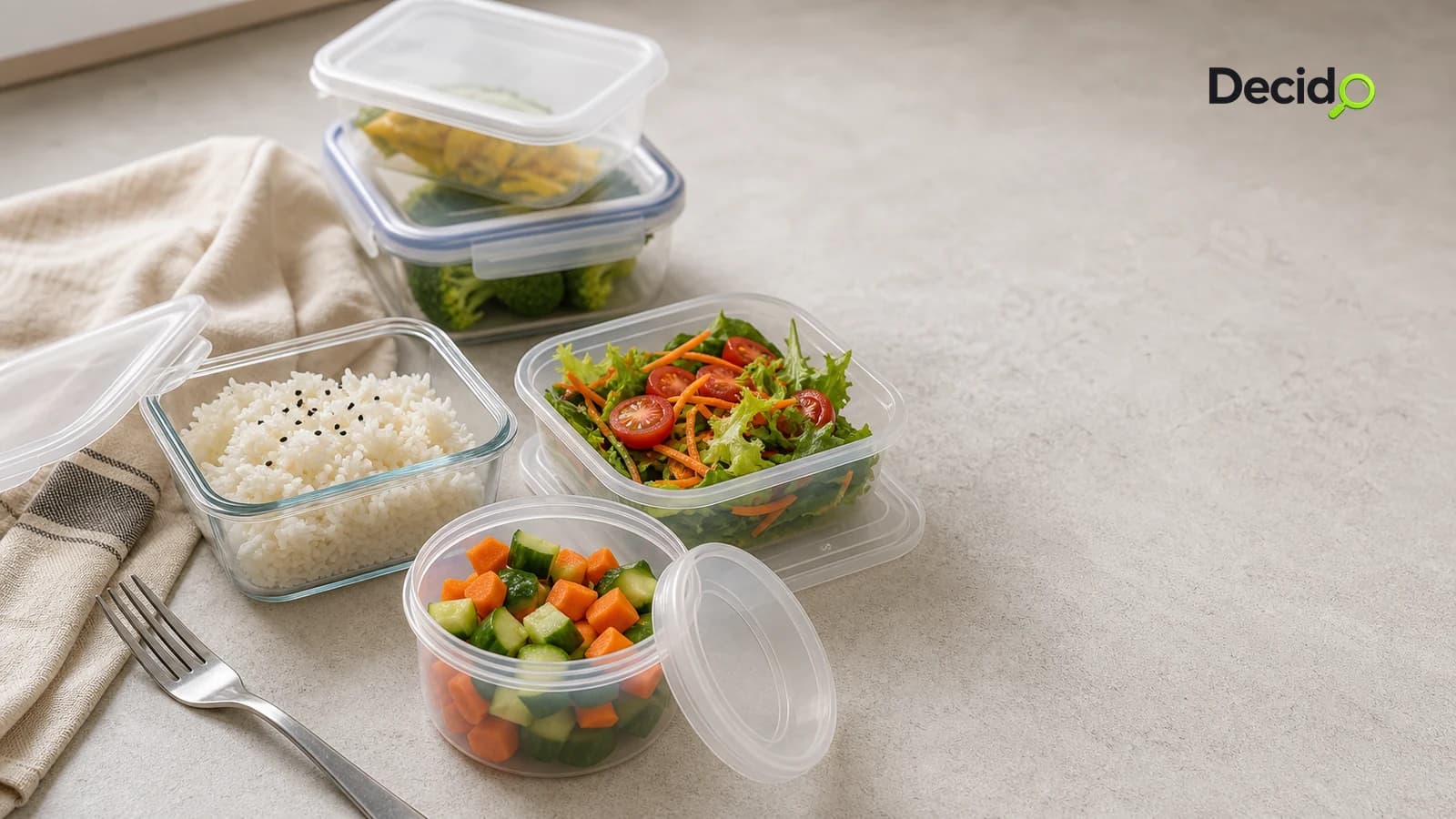
- Prefer glass or stainless steel for hot foods and acidic liquids, especially if storing for a long time. These materials do not release microplastics. And they do not degrade under heat.
You do not have to eliminate plastic from your life. You just need to know that heat transforms it from a container into a source.
Three Things to Remember
Heat is the main driver. Self-heating containers and microwaves are the most critical scenarios. Beyond microplastics, there is the risk of monomers and volatile organic compounds.
Science has the numbers. Regulation has the symbols. But the symbols do not tell you how many particles are released at 80 degrees.
The only way to know what your container contains is to read the heat-resistance symbol. Or have it read by someone with no interest in hiding anything from you.
Cited sources
- Liu X. et al., "Release of microplastics from commonly used plastic containers: Combined meta-analysis and case study", Journal of Hazardous Materials: Plastics, 2025.
- Hussain K.A. et al., "Assessing the release of microplastics and nanoplastics from plastic containers and reusable food pouches: implications for human health", Environmental Science & Technology, 2023.
- Liu G. et al., "Disposable plastic materials release microplastics and harmful substances in hot water", Science of the Total Environment, 2022.
- Xu C. et al., "Safety assessment of polypropylene self-heating food container: The release of microplastics and volatile organic compounds", Food Packaging and Shelf Life, 2024.
- Wang J. et al., "Quantitative analysis of polystyrene microplastic and styrene monomer released from plastic food containers", Heliyon, 2023.