A study published in Environmental Science & Technology in 2023 counted the particles released by plastic cutting boards. The estimate is precise: up to 79.4 million microplastics per year if you use a polypropylene board. It is the first work to systematically quantify dietary exposure from this domestic source.
Plastic is normal in the kitchen. But recent numbers reclassify it from a neutral utensil to a vehicle of exposure.
How Much They Really Release: From 7 Grams to 50 Grams per Year
The study by Yadav et al. (2023) tested cutting boards made of polyethylene (PE) and polypropylene (PP), the two most common polymers. They then simulated chopping and collected the released particles.
The result: PP boards release more mass and more particles than PE boards. The difference ranges from 5% to 60% in mass and from 14% to 71% in number. The distribution is dominated by spherical particles smaller than 100 micrometers. They are invisible to the naked eye and end up directly on the food.
The estimated annual exposure for one person is 7.4-50.7 grams of microplastics from PE boards. For PP, the estimate is about 49.5 grams per year. In terms of particle count, we are talking about 14.5-71.9 million for PE and 79.4 million for PP. These are estimates based on standard domestic use assumptions.
The preliminary toxicity data from the study showed no adverse effects on the viability of mouse fibroblasts exposed for 72 hours. But 72 hours is not a lifetime. And fibroblasts are not the intestine.
The Hole in the Reasoning: New Boards Are Not Immune
A second study, published in Food Additives & Contaminants in 2022 by Habib et al., compared new and worn cutting boards. New boards release fewer particles. But they still release.
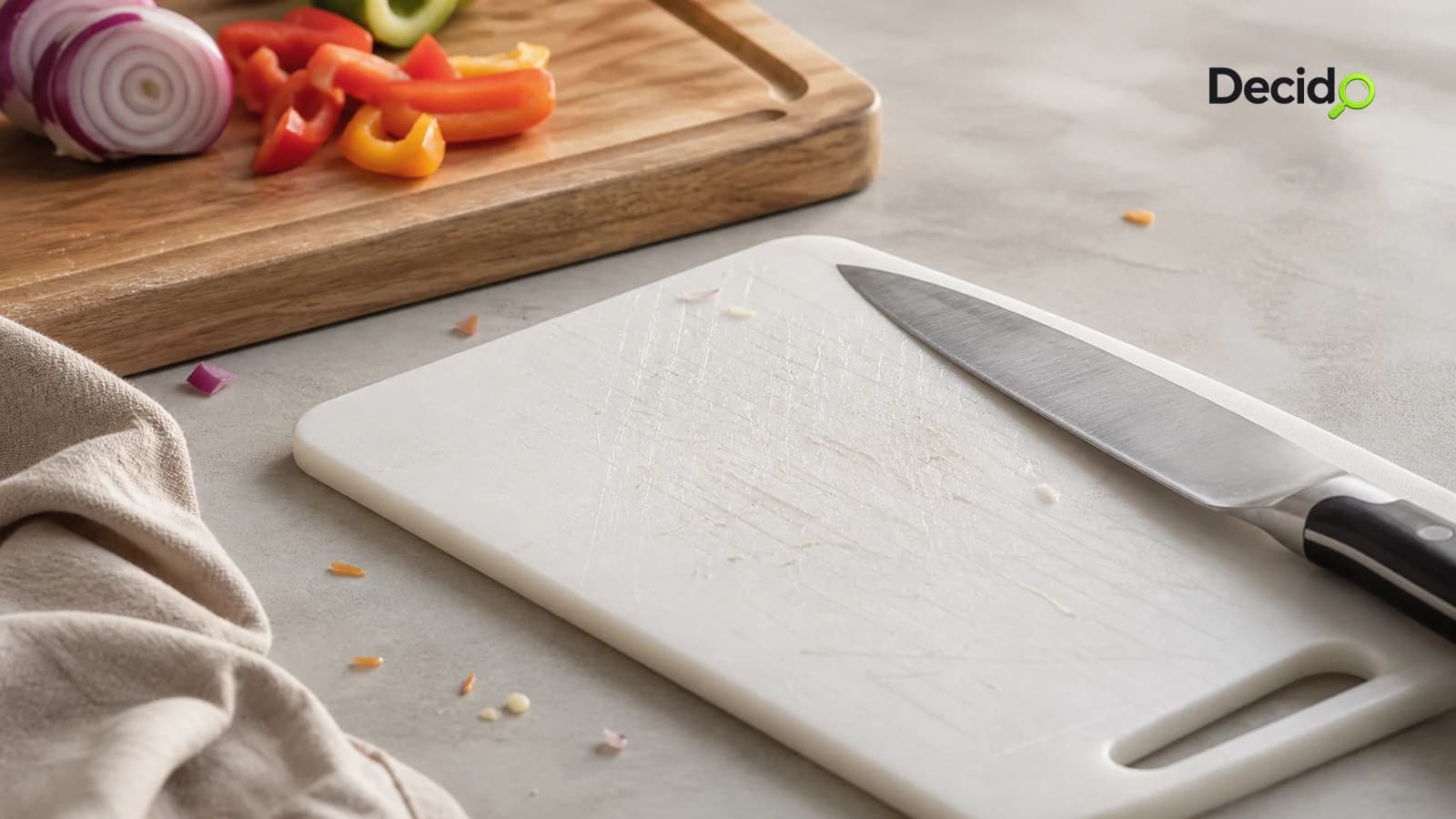
The mechanics are simple: the knife scratches the plastic surface and every movement excises particles. A 2024 review in Heliyon (Snekkevik et al.) confirms that mechanical stress during chopping is the dominant factor of release. The board does not need to be old. You just need to chop on it.
Common sense says that if the surface is smooth it is safe. The data says every knife stroke counts.
What We Know About Health: The First Data on Mice
Yadav et al. (2023) tested cutting-board microplastics on cells in vitro. They found no short-term damage. But absence of evidence is not evidence of absence.
In 2025, Gan et al. published a study in Environmental Science: Processes & Impacts on mice exposed to cutting-board microplastics. They measured intestinal inflammation and alterations in the microbiota. It is the first work to examine the health effects of exposure to this specific source of microplastics.
The results suggest that prolonged exposure can influence the intestinal barrier. No one has yet replicated the study in humans. Causality is not established. But the correlation is documented.
Three Ways to Chop Without Adding Plastic to Your Plate
If you want to reduce exposure, the simplest choices are three.
- Replace worn plastic cutting boards. The study by Habib et al. (2022) shows that wear increases release. A board with visible cuts releases more particles than an intact one.
- Use wood or bamboo boards for acidic or hot foods. These materials do not release microplastics. And science has already compared them: wood boards have different microbiological profiles, but they do not add plastic to the plate.
- Avoid pressing the knife into the plastic with excessive force. Mechanical stress is the driver of release. Less pressure, fewer particles.
You do not have to throw everything away. You just need to know that the plastic-knife-food contact is not inert.
The Question the Study Leaves Open
Plastic cutting boards release measurable amounts of microplastics. Science has the numbers. But it does not yet have the definitive answer on long-term effects on human health.
If 79 million particles per year is the average estimate for a PP board, is food-contact material regulation ready to regulate kitchen utensils too? For now, no specific limit exists for microplastic release from cutting boards.
The only way to know what ends up in your food is to check the utensils you use. Or have them checked by someone with no interest in hiding anything from you.
Cited sources
- Yadav H. et al., "Cutting Boards: An Overlooked Source of Microplastics in Human Food?", Environmental Science & Technology, 2023. DOI: 10.1021/acs.est.3c00924
- Habib R.Z. et al., "Plastic cutting boards as a source of microplastics in meat", Food Additives & Contaminants: Part A, 2022. DOI: 10.1080/19440049.2022.2088113
- Gan H.J. et al., "Simulated microplastic release from cutting boards and evaluation of intestinal inflammation and gut microbiota in mice", Environmental Science: Processes & Impacts, 2025.
- Snekkevik V.K. et al., "Beyond the food on your plate: Investigating sources of microplastic contamination in home kitchens", Heliyon, 2024.