In EU law, a nutrition claim is not a free slogan. Regulation (EC) No 1924/2006 sets conditions for claims such as “low sugars”, “sugars-free”, “with no added sugars” and “light”. That is the starting point, not the conclusion.
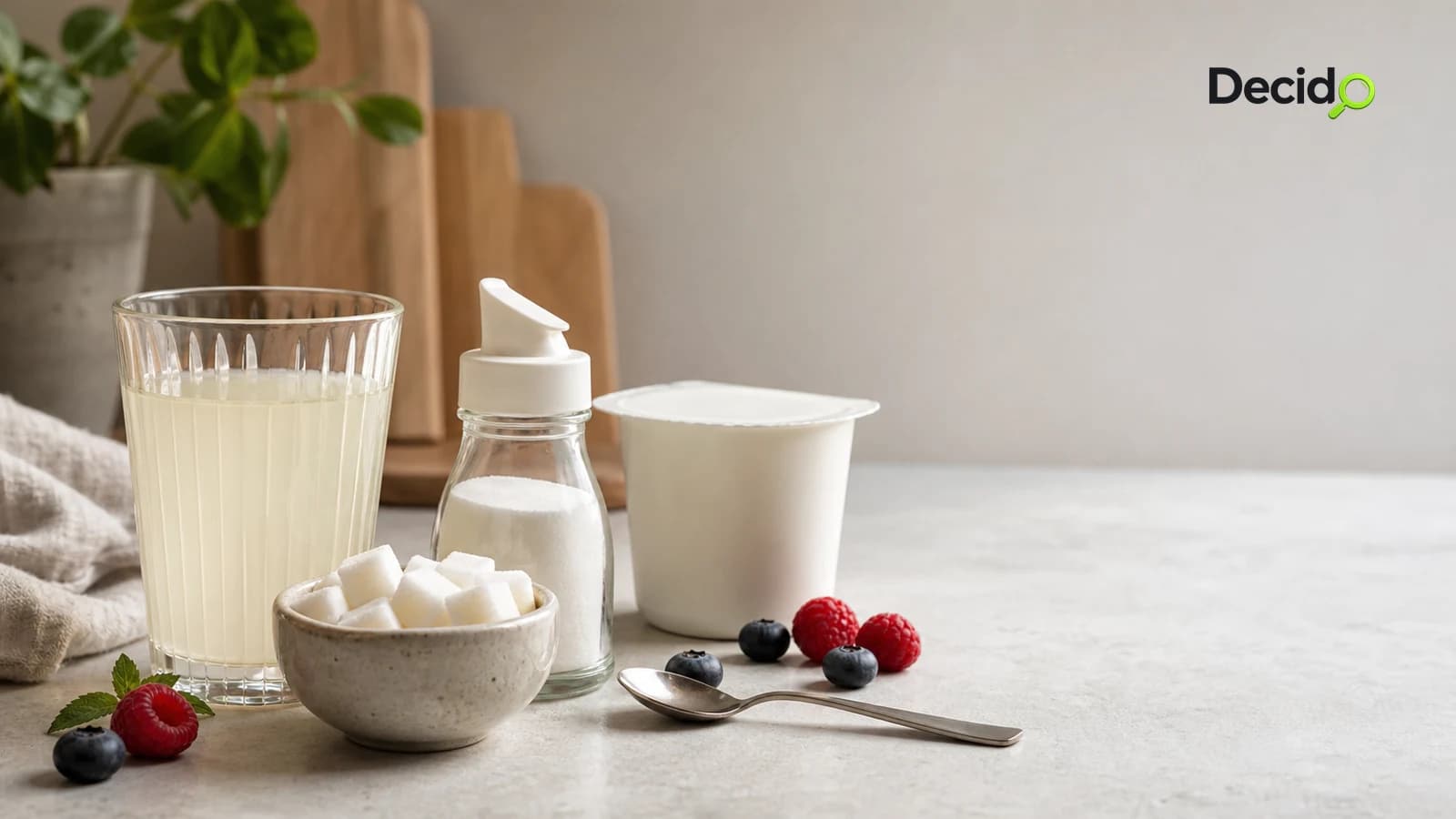
A product with no added sugars can still contain naturally occurring sugars. A “light” product must be read against a comparable product and the nutrient or energy reduction. A drink with sweeteners may reduce sugars compared with the regular version, but the habit still matters.
Read the table before the claim
The nutrition declaration lists carbohydrate and sugars. For comparison, values per 100 g or 100 ml are more useful than the serving suggested by the producer. Serving size may or may not match real use.
Sweeteners: safety and use are different questions
Authorised sweeteners have toxicological assessments and intake limits. In 2023 WHO issued a guideline on non-sugar sweeteners for weight control and NCD risk reduction, while noting that it does not replace safety assessments of individual sweeteners by JECFA or other authorities.
So there are two questions: is a substance authorised within certain limits? And does frequent use of sweetened products help reduce the overall preference for sweet taste? They are related, not identical.
No added sugar is not no sugar
Juices, yogurts, cereals and snacks may carry the claim while still containing naturally occurring sugars from fruit or milk. The phrase is not automatically misleading; it must be read with the “of which sugars” line.
- Read sugars per 100 g or 100 ml before the serving size.
- Check whether the claim concerns total sugars, added sugars or a reduction.
- Look for sugar, syrups, concentrated juices, honey, maltodextrins and sweeteners.
- See whether sugar reduction is compensated by fats, starches or sweeteners.
- Consider frequency: habits matter more than one label.
Conclusion
Sugar and sweetener claims are regulated information, not shortcuts. “Light”, “sugar-free” and “with sweeteners” answer different questions. The stronger reading combines nutrition table, ingredient list and real frequency.
Fonti citate
- Commissione europea, Nutrition and Health Claims, Regolamento (CE) n. 1924/2006.
- Regolamento (UE) n. 1169/2011 sulle informazioni alimentari ai consumatori.
- WHO, Use of non-sugar sweeteners: WHO guideline, 2023.
- EFSA, Tolerable upper intake level for dietary sugars, EFSA Journal, 2022.