The food contact symbol does not answer “glass or plastic?”. It says that an item is intended for food contact, or that its food use is obvious. The practical choice depends on food type, temperature, contact time and the condition of the container.
Glass and plastic solve different problems. Glass is easier to read for hot, fatty or acidic foods. Plastic is light, cheap and practical outside the home. The question is not which material always wins, but which one reduces uncertainty in the scenario in front of you.
Where glass is easier to read
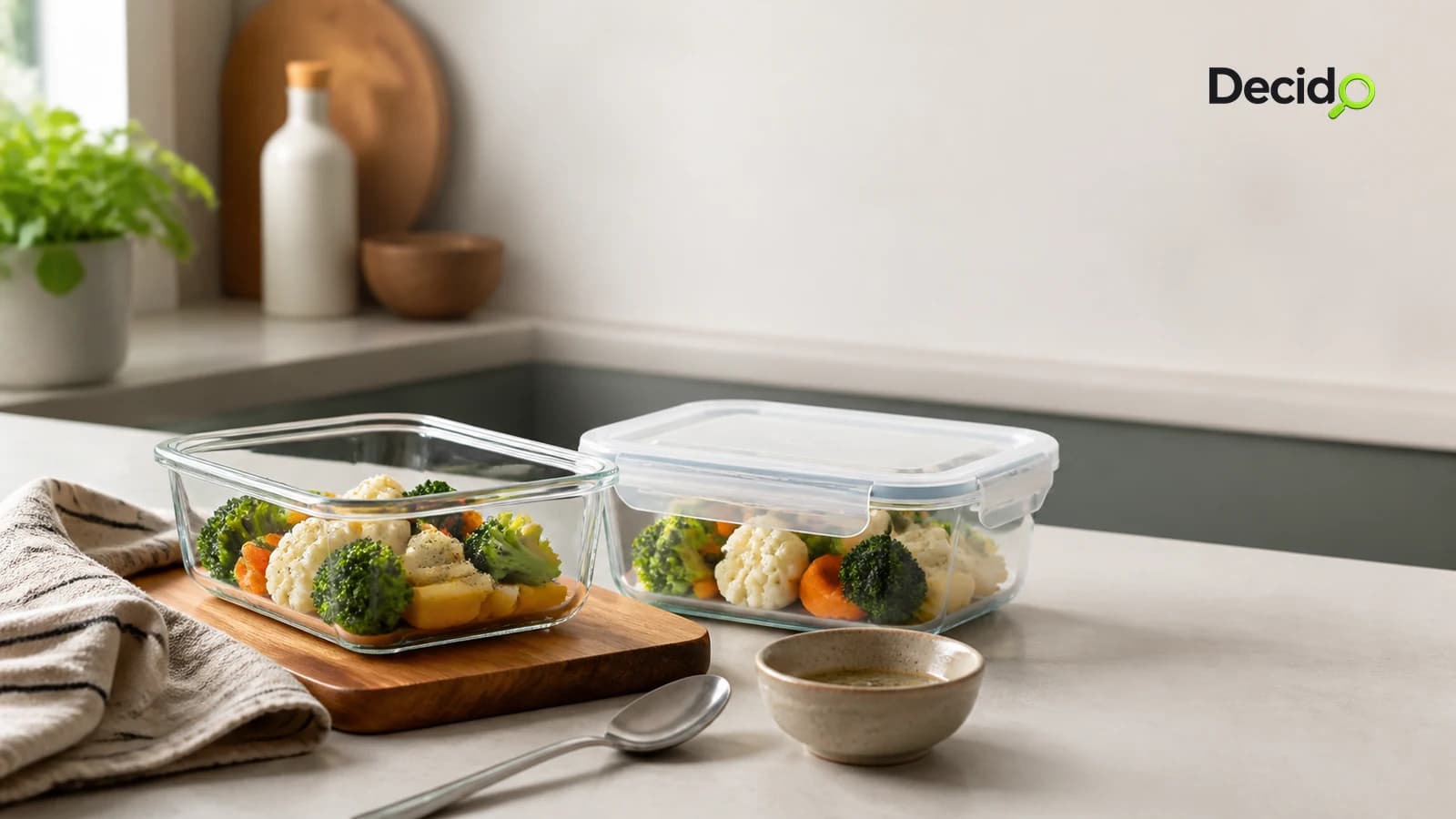
Glass is not a polymer and does not release microplastics. For long storage, fatty foods, acidic sauces or food that is still warm, it often removes some questions about additive migration and surface wear.
It has trade-offs: weight, breakage, storage space and lids or gaskets made from other materials. Microwave use still requires a container declared suitable for that use.
Where plastic remains practical
For transport, freezer storage, light portions and cold or dry foods, a suitable plastic container can make sense. The recycling number is not enough; the object must be suitable for food contact and for the actual conditions.
Heat is the delicate point. Hussain et al. measured microplastic and nanoplastic release in heating scenarios. This does not make every container equivalent, but it makes improvised heating of old, scratched or non-microwave containers a poor assumption.
BPA and the regulatory lesson
In December 2024 the European Commission adopted a BPA ban for food contact materials, taking EFSA's assessment into account. The lesson is useful: material safety is not a generic property of the word “plastic”. It depends on substances, use and evidence updates.
- For hot, fatty or acidic foods, use glass when practical.
- For light cold transport, plastic can be useful if intact and suitable.
- For microwave use, rely only on explicit instructions and intact containers.
- For long storage, avoid scratched, deformed or persistently smelly plastic.
- For meals outside home, balance material stability, weight and breakage risk.
Conclusion
Glass and plastic are not moral categories. Glass is often more predictable with heat, fat and long storage; plastic remains useful when use is cold, short and consistent with instructions.
Fonti citate
- Commissione europea, Food Contact Materials.
- Commissione europea, Food Contact Materials: legislation, quadro su Regolamento (CE) n. 1935/2004 e Regolamento (UE) n. 10/2011.
- Commissione europea, ban del BPA nei materiali a contatto con alimenti, 19 dicembre 2024.
- FDA, Food Packaging & Other Substances that Come in Contact with Food.
- Hussain K.A. et al., Assessing the Release of Microplastics and Nanoplastics from Plastic Containers and Reusable Food Pouches, Environmental Science & Technology, 2023, DOI: 10.1021/acs.est.3c01942.