Regulation (EC) No 1935/2004 does not say that a kitchen object lasts forever. It says that food contact materials must not transfer constituents to food in quantities that endanger health or change the food in an unacceptable way. That condition depends on real use.
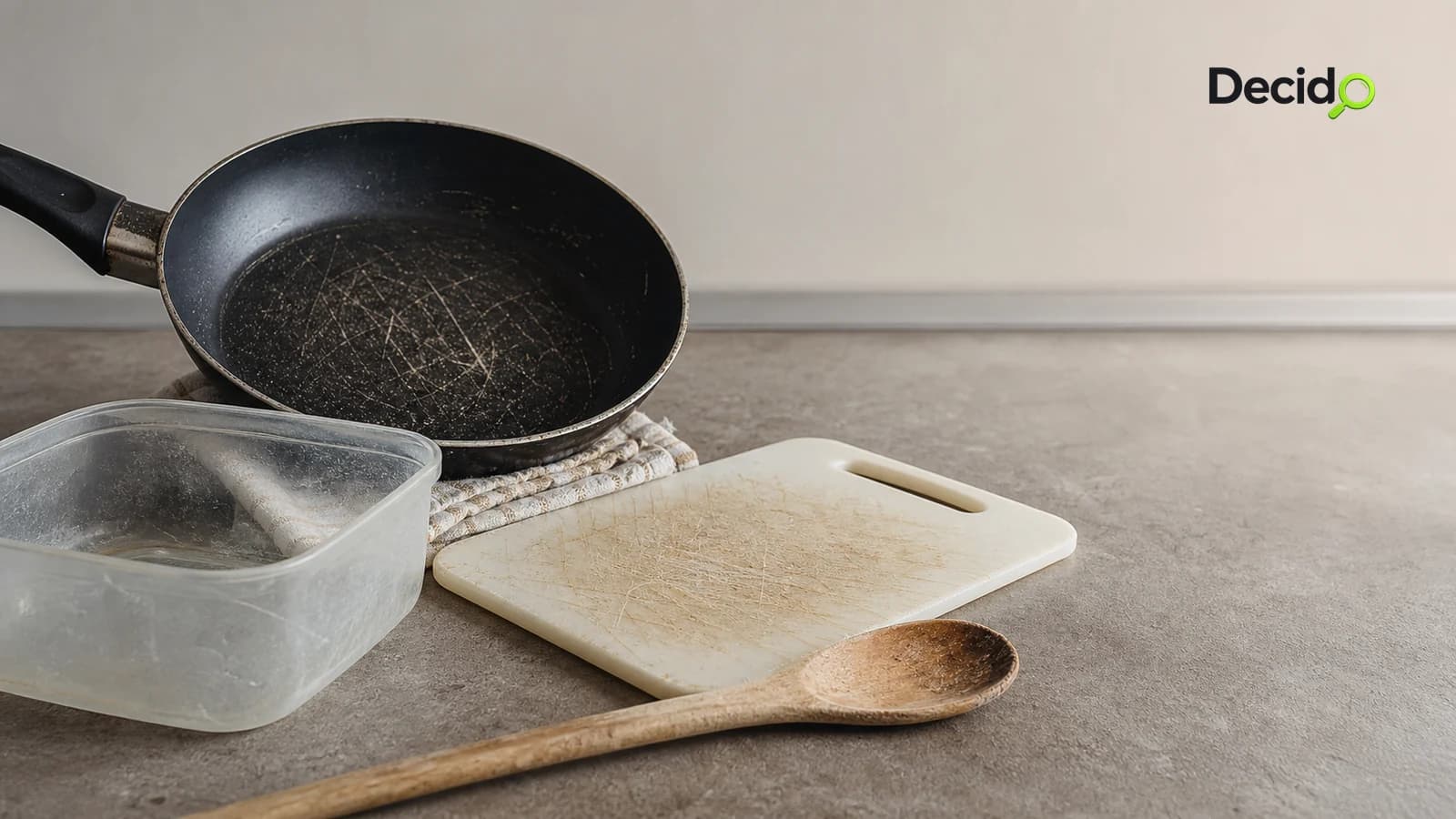
A scratched pan, a cloudy container and a heavily cut board are not the same signal. The useful question is not whether a mark exists. It is whether the surface has become less predictable.
Intended use has limits
Food contact suitability is tied to expected conditions: food type, time, temperature and use. For plastics, EU Regulation No 10/2011 relies on migration tests under standardised conditions. A container designed for cold storage is not automatically suitable for repeated heating.
The same logic applies to aggressive washing, cut surfaces and coatings that have lost integrity. The original declaration matters, but the object in your kitchen today may not behave like the object when it was new.
Pans: coating, scratches and heat
For non-stick pans, the coating is the practical issue. A light mark does not answer everything, but flaking, blistering, peeling or visible particles in food make use less readable. Repeated overheating also changes the question.
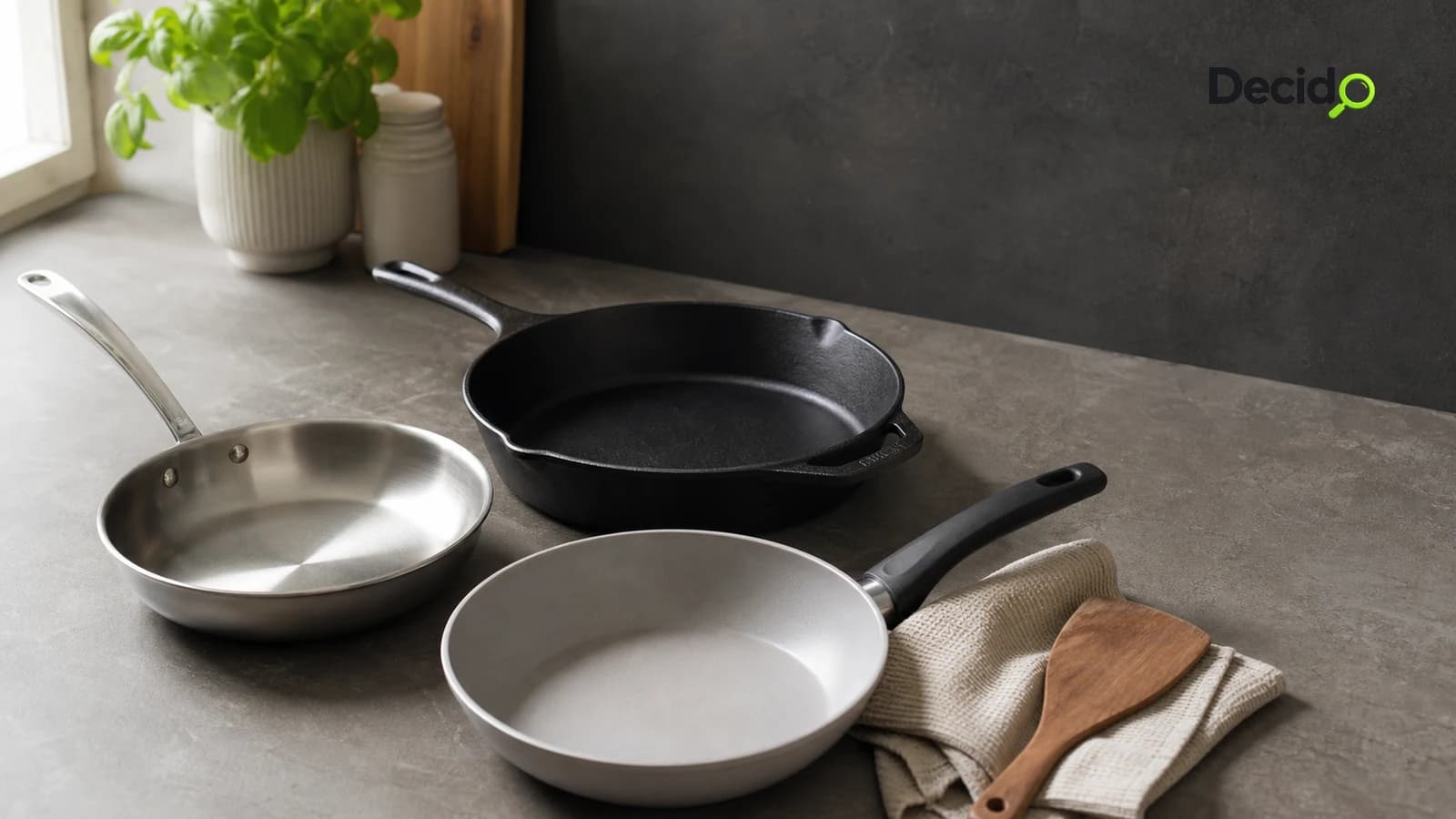
Steel and cast iron have different signals: distortion, unmanaged rust, unstable handles, damaged welds or residues that no longer clean off. A study on stainless steel cookware measured nickel and chromium release during long acidic cooking. That does not make steel a material to avoid; it shows that material and food interact.
Containers: heat, fat and persistent odours
For plastic containers, useful warning signs include strong cloudiness, internal scratches, deformation, odours that remain after washing and lids that no longer seal. Hussain et al. measured microplastic and nanoplastic release in heating scenarios for containers and reusable pouches. The practical message is not panic: do not treat the microwave as equivalent to the refrigerator.
Glass is more stable for many uses, but lids, gaskets and plastic parts still matter. A jar with a damaged lid is not the same as an intact container.
Cutting boards: material is only one variable
A deeply scored plastic board can retain residues and shed particles while cutting. Wood or bamboo can crack, warp or hold moisture if maintained poorly. The decision is not plastic versus wood in the abstract. It is surface, cleaning and food type.
- Replace or downgrade use when coatings flake, blister or leave residue.
- Do not heat containers unless the instructions explicitly allow that use.
- Avoid deeply cut boards for foods that are delicate or ready to eat.
- Treat persistent odours, sticky surfaces and deformation as uncertainty signals.
- Use intact items for the most demanding jobs and keep worn ones only where the use still makes sense.
Conclusion
There is no universal replacement threshold. The practical question is whether the object is still understandable in the conditions in which you use it: intact surface, clear instructions, realistic cleaning and no obvious degradation. When those are missing, uncertainty rises.
Fonti citate
- Commissione europea, Food Contact Materials: legislation, quadro su Regolamento (CE) n. 1935/2004 e Regolamento (UE) n. 10/2011.
- FDA, Food Packaging & Other Substances that Come in Contact with Food.
- Commissione europea, ban del BPA nei materiali a contatto con alimenti, 19 dicembre 2024.
- Hussain K.A. et al., Assessing the Release of Microplastics and Nanoplastics from Plastic Containers and Reusable Food Pouches, Environmental Science & Technology, 2023, DOI: 10.1021/acs.est.3c01942.
- Kamerud K.L., Hobbie K.A., Anderson K.A., Stainless Steel Leaches Nickel and Chromium into Foods during Cooking, Journal of Agricultural and Food Chemistry, 2013, DOI: 10.1021/jf402400v.