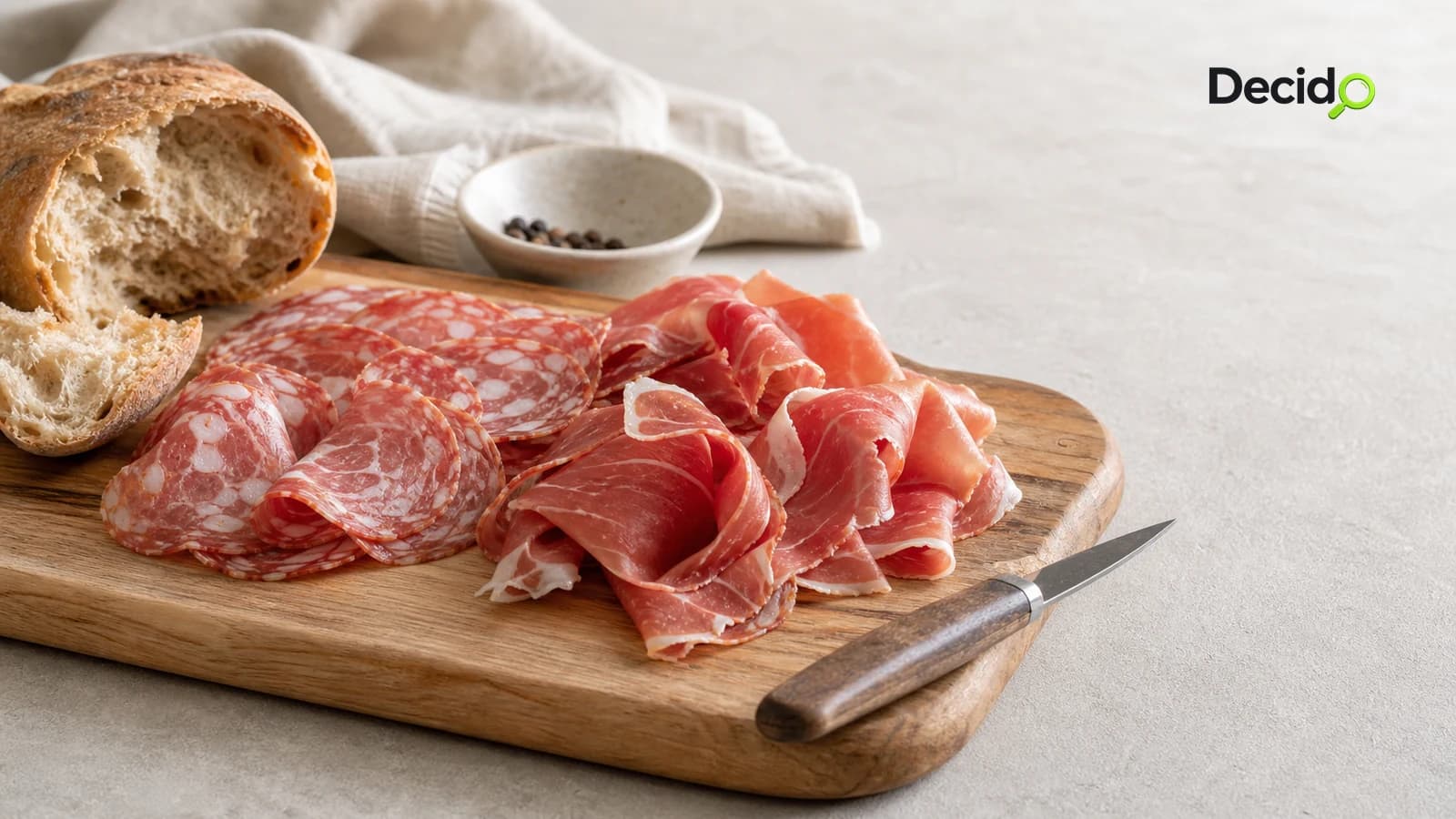
In EFSA's 2017 scientific opinion, under the section on pediatric exposure, there is a precise figure: 0.07 mg/kg. It is the Acceptable Daily Intake (ADI) for nitrite, the ion that turns cured meats pink and protects them from botulinum. EFSA itself wrote, without ambiguity, that children at the highest exposure levels exceed it. Slightly, but they exceed it.
Sodium nitrite (E250) and potassium nitrite (E249) are additives authorised in Europe for decades. They inhibit the growth of Clostridium botulinum, a bacterium that in the absence of oxygen can produce one of the most lethal toxins known. They also give that stable pink colour consumers associate with freshness. They are useful. But the problem is not just cancer. It is also an acute risk, rarely discussed, that hits the youngest.
EFSA and the Limit Children Brush Against
The EFSA Panel on Food Additives and Nutrient Sources added to Food (ANS) published in June 2017 in EFSA Journal (volume 15, issue 6, DOI 10.2903/j.efsa.2017.4786) a re-evaluation of nitrites as food additives. To derive the new ADI, the panel used a BMD (Benchmark Dose) approach, a method that estimates the dose at which a predefined biological response is observed. The result is 0.07 mg of nitrite ion per kilogram of body weight per day.
For the general population, exposure from food additives does not exceed this value. But there is an exception. At the 95th percentile of exposure — that is, among children who eat the most — EFSA recorded a slight exceedance of the ADI.
The agency calls it "slight exceedance". It is not a red alert. But it is a signal. And EFSA signals are meant to be read.
The approach is conservative. The ADI already includes uncertainty factors. Yet the exceedance is there. Not for everyone. For those who eat more cured meats than average. And children, kilo for kilo, eat more than adults.
IARC Classifies Processed Meat as Carcinogenic (Group 1)
In 2018, the International Agency for Research on Cancer (IARC) published volume 114 of its monographs. The conclusion is clear: processed meat is carcinogenic to humans (Group 1). Red meat is "probably carcinogenic" (Group 2A). The classification is based on consistent epidemiological evidence, particularly for colorectal cancer.
The presumed mechanism passes through N-nitrosamines. Added nitrites react with amines present in meat, especially during cooking or preservation, forming known carcinogenic compounds. WHO, in a 2015 Q&A document, estimates that eating 50 grams of processed meat per day increases colorectal cancer risk by about 18%.
But there is a crucial distinction. IARC classifies the finished product, not the single additive. Processed meat is a cocktail: nitrites, smoking processes, high-temperature cooking, other additives.
No RCT (randomised controlled) studies in humans isolate the carcinogenic effect of nitrites alone. The direct nitrites → cancer causality in humans has not been demonstrated with the gold standard of clinical research.
The evidence is strong, but it is epidemiological. And epidemiology measures associations, not causes.
The Risk Cured Meats Don't Mention: Methemoglobinemia
When nitrites are discussed, public debate always ends up on cancer. Infant methemoglobinemia, the so-called "blue baby syndrome", is rarely named. Yet it is the most immediate risk.
About 5-8% of ingested nitrates are converted into nitrites in the human body, through bacteria in saliva and the intestine. In infants, this conversion is faster and more dangerous. Different gastric pH and immature bacterial flora favour the transformation. Nitrites oxidise haemoglobin into methemoglobin, which does not carry oxygen. The result is cyanosis. In the worst cases, asphyxia.
In EFSA's opinion on nitrates (E 251, E 252, EFSA Journal 2017;15(6):4787), this conversion is described as the reason why infants are the most vulnerable population. And it does not take extreme consumption. Levels of nitrates in water or diet that would be harmless for an adult are enough.
There is also older evidence, but no less significant for that. A case-control study by Preston-Martin et al., published in Cancer Epidemiology, Biomarkers & Prevention in 1996 (PMID 8824361), compared 540 children with brain tumours and 801 controls.
Mothers who during pregnancy had consumed above-median quantities of cured meats showed a higher risk.
It is a pioneering study. It is also dated. No one has replicated it with more modern designs. But it remains the only work that directly links maternal consumption of cured meats to paediatric brain tumours.
Vegetables vs Cured Meats: The Difference That Changes Everything
Nitrates are not only in cured meats. They are also in rocket, beetroot, spinach. In notable quantities. Yet no one classifies rocket as carcinogenic. Why?
Zhong et al., in a study published in Molecular Nutrition & Food Research in 2022 (DOI 10.1002/mnfr.202100272, PMID 34792849) and in an update in American Journal of Clinical Nutrition in 2025 (DOI 10.1016/j.ajcnut.2025.01.031, PMID 40318878), built a food composition database for nitrates and nitrites. Their conclusion is clear: health effects depend on the food source, not just the molecule. Vegetables contain antioxidants — vitamin C, polyphenols — that inhibit nitrosation, that is, the formation of N-nitrosamines. Cured meats do not.
It is a distinction that public debates systematically ignore. "Nitrates" has become a generic term, used to scare or defend indiscriminately. But nitrite added to a mortadella is not biologically equivalent to natural nitrate from a beetroot. The food matrix matters. Cured meats do not win this comparison.
If You Want to Reduce the Risk, Here Are the Simplest Choices
No one has to stop eating cured meats by decree. But if you want to reduce exposure, especially for children, the choices exist and are concrete.
- Limit frequency, not necessarily quantity in a single meal. Risk grows with cumulative dose. Occasional consumption has a different profile from daily consumption.
- For infants, cured meats are not indicated. For small children, it is better to limit them. EFSA flagged the ADI exceedance precisely in children. Their weight is low, the relative dose is high, and methemoglobinemia is a real risk.
- Accompany cured meats with sources of vitamin C. Citrus fruits, peppers, kiwi. Vitamin C inhibits the formation of N-nitrosamines in the stomach. It does not cancel the risk, but it attenuates it.
- Prefer fresh meat or meat preserved with alternative methods. Vacuum packing, freezing, salting without nitrites. Products on the market use these routes. They are less stable in colour and have a shorter shelf life. But they exist.
- Read the label. Nitrites are E249 (potassium nitrite) and E250 (sodium nitrite). If they are on the list, the product contains them. If they are not on the list, the pink colour is not guaranteed by synthetic chemistry.
The limit is 0.07 mg/kg. For a 15-kilogram child, that is just over one milligram per day. EFSA says those at the 95th percentile of consumption exceed it. IARC says processed meat is carcinogenic.
Neither agency says "never eat cured meats". They say the risk exists, that it grows with the dose, and that children are more exposed.
Science does not have the gavel of moral judgment. It only has numbers. And the only way to know whether you, or your child, are inside or outside that number, is to read what you eat. Or have it read by someone who has no interest in hiding anything from you.