In 1968, a letter to the New England Journal of Medicine signed by Robert Ho Man Kwok coined a name: "Chinese Restaurant Syndrome". Since then, monosodium glutamate has been judged more by popular culture than by regulatory documents. The documents tell a less dramatic story, but not a completely empty one.
Glutamate is not an exotic laboratory chemical. It is part of umami taste, identified by the Japanese chemist Kikunae Ikeda in 1908. Today it is found in sauces, broths, snacks and ready meals, often under the code E621. The question is not whether glutamate is toxic in itself. The question is what happens when free glutamate is added to foods, in which quantities, and for whom the margin is narrower.
FDA, JECFA and EFSA: Three Different Answers
The FDA classifies monosodium glutamate as GRAS: Generally Recognized As Safe. Its public Q&A requires labelling when MSG is added as an ingredient, but not for glutamate naturally present in foods such as tomatoes or parmesan. The FDA also recognises that some sensitive people may experience transient symptoms — headache, tingling, flushing — after large amounts, especially without food.
JECFA, the joint FAO/WHO committee, maintains a group ADI "not specified" for L-glutamic acid and its ammonium, calcium, monosodium, magnesium and potassium salts. In regulatory language, that means the available data and expected exposure do not require a numerical daily limit under the stated conditions of use.
EFSA changed the European picture in 2017. In its re-evaluation published in EFSA Journal (DOI: 10.2903/j.efsa.2017.4910), the panel derived a group acceptable daily intake of 30 mg/kg body weight per day, expressed as glutamic acid, for glutamic acid and glutamates E620-E625. The basis was a neurodevelopmental toxicity study in rats, with a NOAEL of 3,200 mg monosodium glutamate/kg body weight per day and the standard uncertainty factor of 100.
Three agencies, three framings. FDA: generally safe with labelling. JECFA: ADI not specified. EFSA: numerical group ADI.
The Syndrome That Became Bigger Than the Evidence
The 1968 letter generated decades of alarm. A critical review published in Drug Research in 2016 (Obayashi and Nagamura, DOI: 10.1055/s-0036-1590509) examined double-blind controlled studies on headache. Result: most do not find a significant difference between MSG and placebo in inducing headache. In many cases, symptom perception appears mediated by expectation. The nocebo effect is part of the file.
That does not mean nobody reacts. It means the popular label "Chinese Restaurant Syndrome" is too broad and culturally loaded for what controlled studies can support. A better wording would be narrower: some individuals report transient symptoms after high doses of added MSG, especially when consumed without a meal matrix.
Children and High Exposure: Where EFSA Was More Cautious
EFSA's numerical ADI matters because exposure estimates can exceed it in some scenarios. In the 2017 opinion, the panel noted that estimated exposure to added glutamates could exceed the group ADI for several population groups at high intake levels. Children are relevant because body weight is lower and packaged savoury foods can concentrate exposure.
This does not mean that a bowl of soup with E621 is a toxic event. It means the margin is not infinite. The difference between occasional use and repeated intake from snacks, sauces, bouillon cubes and ready meals matters.
The mechanism is simple enough to understand. Glutamate added as MSG is "free". Natural glutamate in foods is often bound to proteins or embedded in a whole-food matrix. Free glutamate is absorbed differently. Whether that difference is clinically meaningful at realistic doses remains the contested point.
How to Read the Label
If you want to reduce added MSG exposure, the label gives you the practical route. Look for monosodium glutamate, glutamate monosodico, E621, or related additives E620-E625. Yeast extract, hydrolysed proteins and flavourings can also increase free glutamate, even when E621 is not named directly.
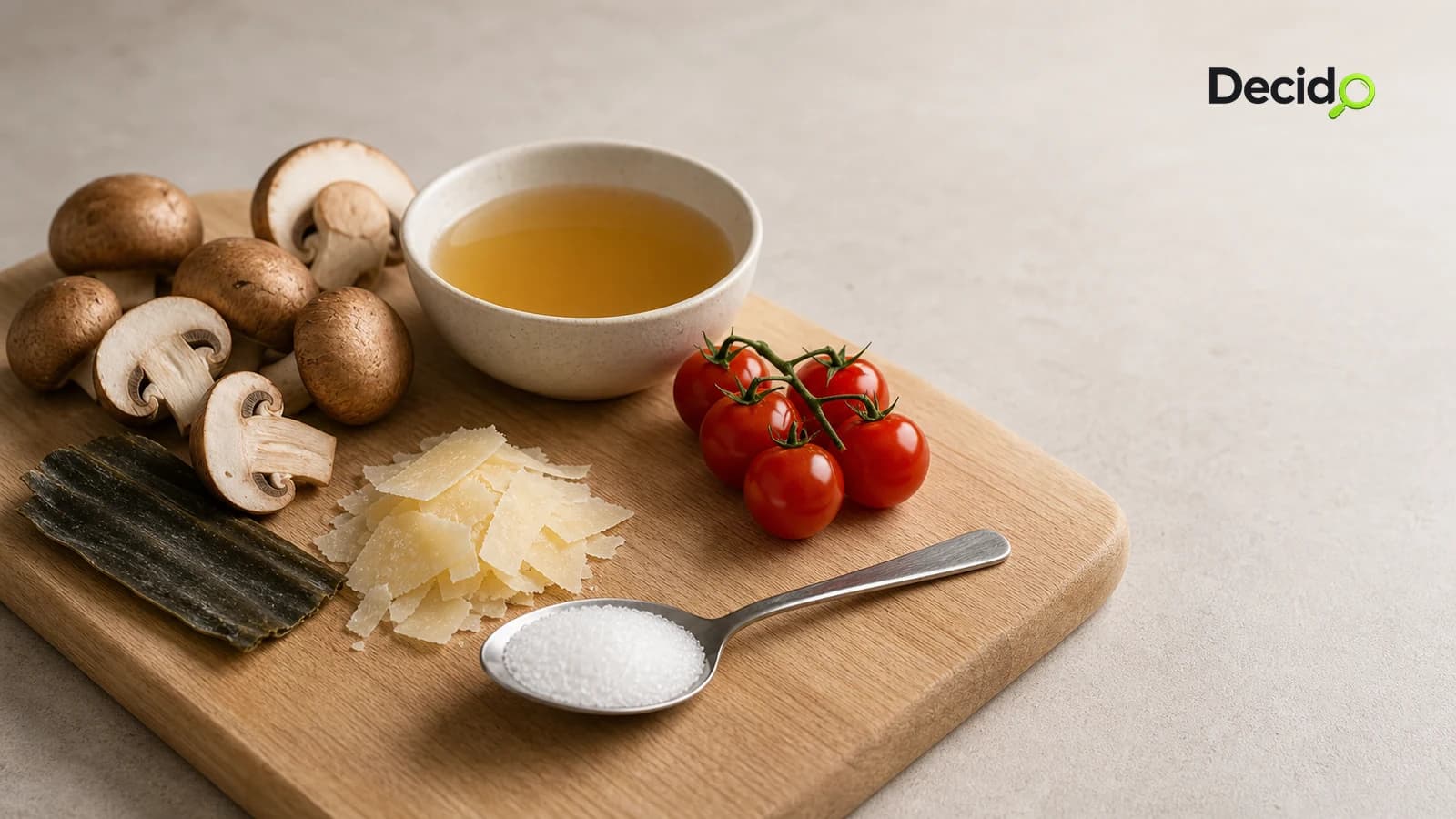
The useful distinction is not "natural equals safe" and "additive equals dangerous". Tomatoes, parmesan and mushrooms naturally contain glutamate. The question is added concentration, total diet and frequency.
For children, the conservative choice is to limit repeated exposure from the most concentrated processed sources: instant noodles, bouillon cubes, savoury snacks and ready sauces. Not because one serving proves harm, but because EFSA's 30 mg/kg/day number gives the discussion a measurable reference.
Conclusion
The Chinese Restaurant Syndrome story is weaker than its reputation. Controlled studies do not support the broad cultural myth. But the regulatory file is not blank: EFSA set a numerical group ADI in 2017, while JECFA still keeps an ADI not specified and the FDA treats MSG as generally safe.
That is the real finding. Not panic, not dismissal. A flavour enhancer can be safe for most people and still deserve a closer look when exposure is repeated, concentrated, or aimed at children. The only way to know where you are is to read the ingredient list.
Cited sources
- EFSA ANS Panel, "Re-evaluation of glutamic acid (E 620), sodium glutamate (E 621), potassium glutamate (E 622), calcium glutamate (E 623), ammonium glutamate (E 624) and magnesium glutamate (E 625) as food additives", EFSA Journal, 2017. DOI: 10.2903/j.efsa.2017.4910.
- EFSA, "EFSA reviews safety of glutamates added to food", 2017.
- JECFA, evaluation of L-glutamic acid and glutamate salts, ADI not specified.
- FDA, "Questions and Answers on Monosodium Glutamate (MSG)".
- Obayashi Y. and Nagamura Y., "Does monosodium glutamate really cause headache?", Drug Research, 2016. DOI: 10.1055/s-0036-1590509.