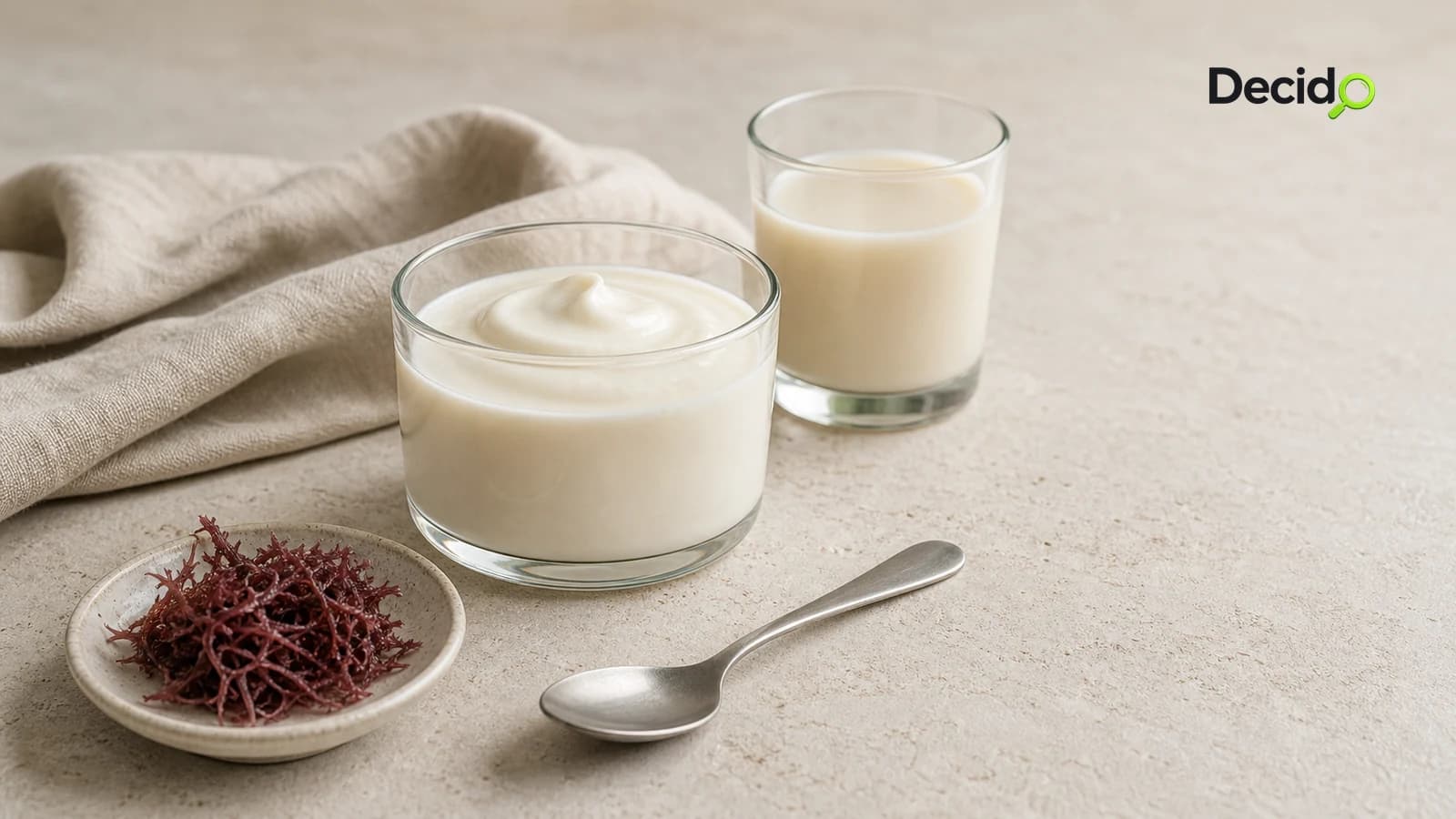
When a label says “natural”, the mind tends to close the file. Carrageenan comes from red seaweed and is used to give body to plant drinks, cream, desserts, ice cream and ready meals. That does not automatically make it irrelevant.
The useful question is not whether carrageenan is natural or chemical. The question is which form is used, at what dose, in which food and with what safety margin.
The distinction the label does not explain
E407 is food-grade carrageenan. E407a is processed Eucheuma seaweed. Both are used as thickeners, stabilisers and gelling agents. The critical point is not to confuse them with degraded carrageenan, often called poligeenan, which is used in experimental settings and is not authorised as a food additive.
This matters because many worrying studies involve degraded forms, high doses or cell and animal models. They are signals to read, not direct verdicts on occasional dietary exposure.
What EFSA actually said
In 2018, the EFSA ANS Panel re-evaluated carrageenan and processed Eucheuma seaweed. The opinion did not say “no issue”. It kept a group acceptable daily intake of 75 mg/kg body weight per day, while asking for better data on molecular weight, low-molecular-weight fractions and exposure in children.
So the additive was not banned. But the evaluation is not a blank cheque. It is a regulatory decision inside a defined perimeter: additive quality, impurity limits, amount used and more exposed groups.
Why the science remains disputed
Concerns mainly come from intestinal cell studies and animal models. Tobacman's 2001 review collected signals of gastrointestinal effects in animal experiments. Later work, including studies by Bhattacharyya and colleagues, explored inflammatory pathways in cellular models.
These data do not allow a simple conclusion. A cell study is not a human diagnosis. An animal model is not a normal diet. But they explain why carrageenan should not be dismissed with “it comes from seaweed”.
How to read the label
If you want to reduce repeated exposure, look for “carrageenan”, “E407” or “E407a”. You will mostly find it in products that need a creamy or stable texture: plant milks, spray cream, desserts, ice cream, sauces and some diet products.
- Check frequency: occasional exposure is different from several E407 products every day.
- Pay attention to children: for the same portion, dose per kilogram of body weight is higher.
- Compare simpler alternatives: some products use pectin, starches, guar gum or no thickener.
Conclusion
Carrageenan is not a clean story for either side. It is not an additive to demonise, but it is not a word to ignore because it sounds natural. EFSA kept it authorised within limits and with data requests; some studies raise questions about forms, doses and models that are not equivalent to normal consumption.
The practical choice is less dramatic: read the label, look at frequency and decide whether that thickener is occasional or part of your daily pattern.
Cited sources
- EFSA ANS Panel, re-evaluation of carrageenan (E407) and processed Eucheuma seaweed (E407a), EFSA Journal, 2018.
- Tobacman J.K., “Review of harmful gastrointestinal effects of carrageenan in animal experiments”, Environmental Health Perspectives, 2001.
- Bhattacharyya S. et al., carrageenan-induced inflammatory and metabolic effects, Diabetes, 2012.
- Carthew P., safety review of carrageenan and processed Eucheuma seaweed, 2002.